Don't invest unless you're prepared to lose all the money you invest. This is a high-risk investment and you are unlikely to be protected if something goes wrong. Take 2 mins to learn more.
Don't invest unless you're prepared to lose all the money you invest. This is a high-risk investment and you are unlikely to be protected if something goes wrong. .
98% of the UK's wall insulation upgrades are defective. Kestrix aims to fix that
Syndicate Room
June 26, 2026
•
5 min read
The UK is about to spend £15 billion upgrading up to 5 million homes by 2030. It is one of the largest retrofit commitments in the country's history. And we are starting it with almost no scalable way to check the work.
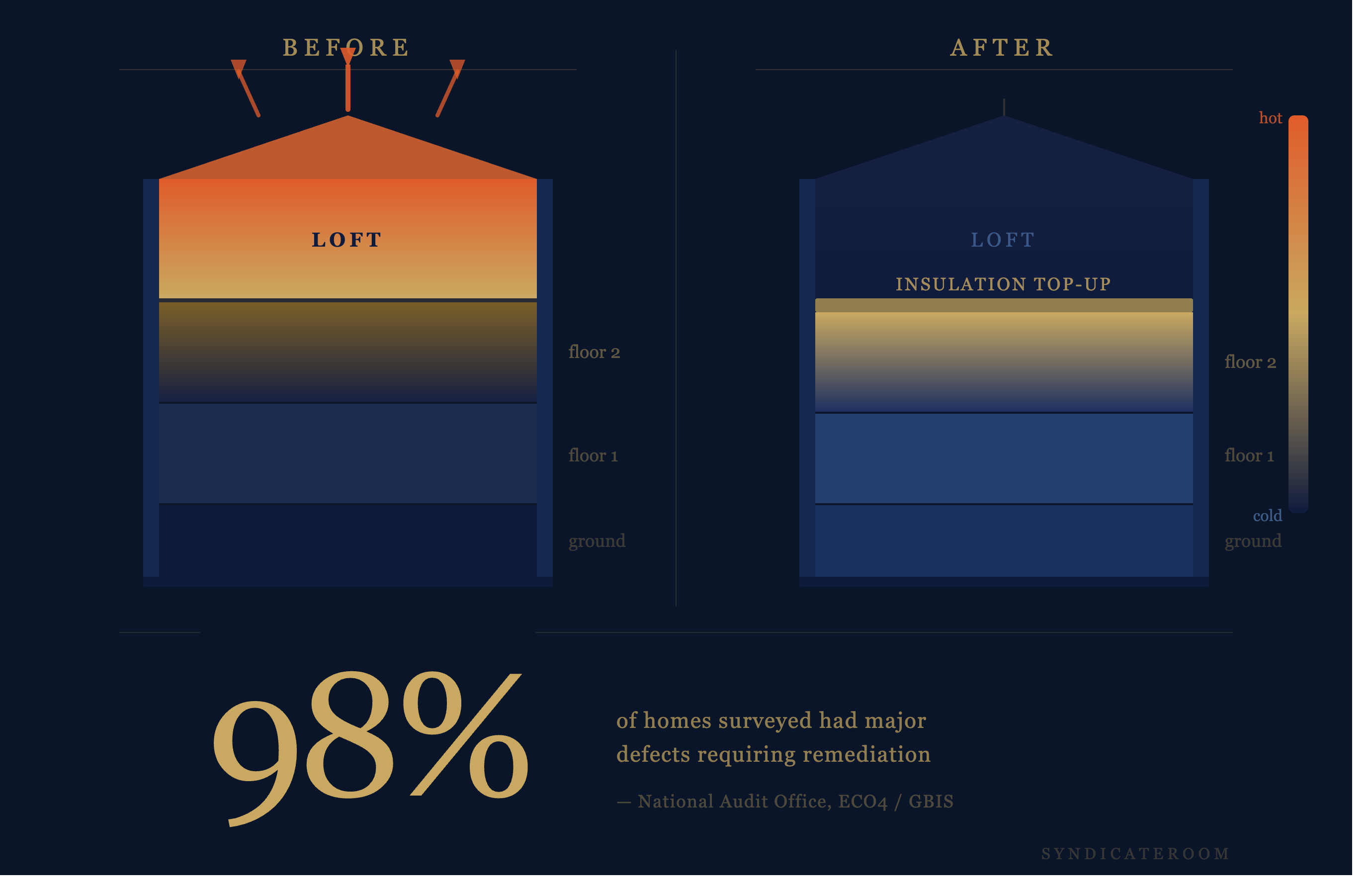
What’s more, when the National Audit Office examined homes that had external wall insulation fitted under the ECO4 and Great British Insulation schemes, it found 98% had major defects requiring remediation, problems that can cause damp and mould rather than lower bills. We have been paying for upgrades, at scale, with no reliable way to verify they worked.
And that is exactly the problem that my latest Angel Insights guest can solve. Lucy Lyons is co-founder and CEO of Kestrix, the company sometimes described as the "Google Maps of heat loss." Their first product uses thermal and visual imaging drones flown over buildings to map exactly where heat is escaping, and they have already covered around 12,000 homes. But that is only the start of what they are building.
Listen to the full episode on Spotify
A market that hasn't changed in over 30 years
The way we survey buildings is the quiet scandal underneath the retrofit push. The standard tool is the Energy Performance Certificate (EPC), the A-to-G rating you see when you buy or rent. Most people assume it measures how efficient a home is. But that’s not quite right.
"It was supposed to be about energy efficiency," Lucy explains, "but really under the hood, EPC’s are designed to tell you how much it costs to run your house, not how efficient it is."
The alternative, if you want to know what is actually happening inside the walls, is to hire a building physics consultant. Expensive, invasive, slow. So most retrofit decisions get made on thin data, or on a single generic recommendation: put solar on the roof and hope. If this doesn’t change soon, we will see £15 billion of public money flow into a system that surveys buildings the same way we did it three decades ago, one single clipboard at a time.
The insight: heat you can see
Kestrix began with a frustration that Lucy's co-founder Matt couldn't shake. A former Google product manager with a background in physics and computer vision, he wanted to make his own home more energy efficient and, despite his training, couldn't work out the first thing to do. As a hobbyist drone pilot, he flew one over his house and built a 3D thermal reconstruction. You could, it turned out, see the heat leaking out.
The company that grew from that does far more than take pretty thermal pictures. Kestrix flies thermal and RGB imaging drones over whole neighbourhoods, then maps and quantifies where heat is escaping and models the optimal retrofit plan for each building, where solar could sit, whether a heat pump would even be noise-compliant given the distance to a neighbour's window.
"More than the Google Maps of heat loss, Kestrix is the data layer to inform energy-resilient building upgrades."
Crucially, Lucy steered the company away from the obvious consumer play. "Selling to consumers sounds awful," she told me, "especially when only a handful of people actually care about the environment." Instead, Kestrix sells to the people who own thousands of buildings at once: social housing providers and the contractors delivering retrofit at scale.
Why the co-founder mattered more than the idea
There is a founder lesson in the Kestrix story that I think every angel should internalise. Lucy and Matt met at Carbon 13, the climate-tech venture builder, at what amounts to a co-founder speed-dating event. They had no obvious overlap. What Lucy screened for wasn't shared interests.
"What I was really focused on is, can this person listen? Is this person thinking big? Is this person all in?"
Four years on, the partnership is the engine of the business. As Lucy puts it, "at the beginning it's much less about what you do and much more about who you do it with." For early-stage investors, where the team is the asset, that is the whole game.
98% of homes with external wall insulation under ECO4 and the Great British Insulation Scheme had major defects requiring remediation — National Audit Office
The real moat is the data
The obvious sceptic's question, in 2026, is whether any of this is defensible. Can't an AI model just do it? Lucy's answer is the sharpest part of the conversation, and the part most relevant to an investment thesis.
"We're now in a world where AI is limited really only by its training data," she says. And the training data for thermal building analysis doesn't exist, because nobody has captured it at scale. Kestrix has flown some 12,000 houses, gathering high-resolution thermal and visible-spectrum images at the correct times of day and year, from the correct angles, then built a pipeline that aligns the two. That is years of structured, cleaned, proprietary data that a well-funded generalist cannot conjure overnight.
This is the same pattern we have seen in other strong climate and data businesses: the defensibility isn't the model, it's the dataset feeding it. In Kestrix's case it compounds with every building flown.
Traction, and proof it works
The thesis is already earning evidence. Working with the Peabody Trust, Kestrix flew homes before and after loft insulation top-ups and correctly isolated the change, estimating the energy and carbon savings, and spotted other issues an EPC assessor would never see, such as thermal bridging around window lintels. Lucy describes the output as "almost like a building passport," a persistent record a housing provider can act on for years.
The commercial logic is sound too. Verified outcomes let housing providers hold contractors to a higher standard and underpin "pay for performance" models the sector is moving towards. And the opportunity isn't UK-only: Kestrix has launched its first US pilot with municipal utilities in Massachusetts, a state sitting on billions of dollars of energy-efficiency rebates.
"You have to have a crystal clear vision of a wild future, but also a crystal clear pathway for the next steps you have to take in the 12 to 18 months ahead of you."
The investment context
Kestrix sits at the intersection of two things our data likes. The first is climate tech as a category: UK climate-tech investment grew 24% to £4.5 billion in 2024 while much of the world pulled back, and AI-driven climate-tech in particular is where capital is concentrating. The second is the discipline of early-stage investing itself. SyndicateRoom's analysis of UK Companies House data shows startup returns follow a power law, with the top 6% of companies generating around 80% of all portfolio value. You catch those outliers by backing real businesses early, at sensible valuations, and by diversifying widely enough to be in the game when one breaks out.
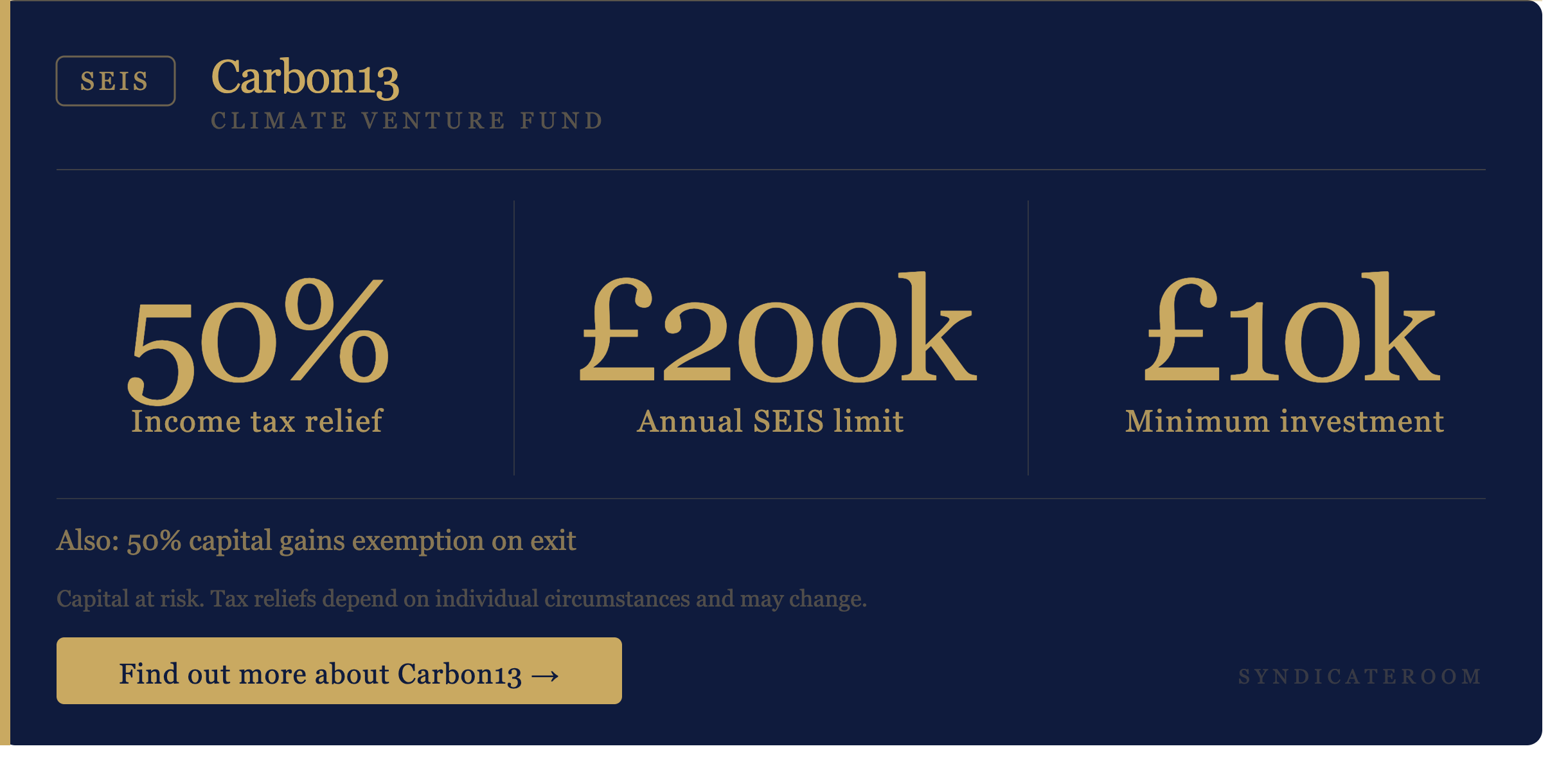
Kestrix is exactly the profile of company that emerges from Carbon 13, the venture builder where Lucy and Matt met. For investors who want exposure to that pipeline of pre-seed climate founders, SyndicateRoom runs a Carbon13 SEIS Fund: a portfolio of 6 to 10 early climate-tech companies, with 50% income tax relief on up to £200,000 and 50% capital gains exemption, from a £10,000 minimum.
If the next decade of returns is being built anywhere, the unglamorous, data-rich corners of the energy transition are a strong candidate. Kestrix is one to watch.
Find out more about the Carbon13 SEIS Fund and how to back early-stage UK climate tech this tax year.
Download your Carbon13 SEIS Fund brochure
Carbon13 seeks to meticulously craft investment portfolios that not only navigate the complexities of high-emission sectors but also propel the groundbreaking ventures of tomorrow. Register to download the brochure.
Related Articles
About the author
Syndicate Room|
Syndicate Room is authorised and regulated by the Financial Conduct Authority.
Investing in early-stage businesses involves risks, including illiquidity, lack of dividends, loss of investment and dilution, and it should be done only as part of a diversified portfolio. Tax relief depends on an individual’s circumstances and may change in the future. In addition, the availability of tax relief depends on the company invested in maintaining its qualifying status. Past performance is not a reliable indicator of future performance. You should not rely on any past performance as a guarantee of future investment performance.
This page has been approved as a financial promotion by Syndicate Room Ltd, which is authorised and regulated by the Financial Conduct Authority (No. 613021).
We use cookies to improve our service. By continuing to use this site you are agreeing to their use. Find out more. .