Don't invest unless you're prepared to lose all the money you invest. This is a high-risk investment and you are unlikely to be protected if something goes wrong. Take 2 mins to learn more.
Don't invest unless you're prepared to lose all the money you invest. This is a high-risk investment and you are unlikely to be protected if something goes wrong. .
The number every founder should know cold: 6 sales checks angels make
Syndicate Room
October 14, 2026
•
9 min read
Most startups don't fail because the product is bad. They fail because nobody can sell it. Emma Maslen, an Angel Academe angel and CEO of sales consultancy inspir'em, runs six sales checks before she backs a founder. The first is one number every founder should be able to quote cold: closed new revenue for the period.
A founder stands in front of a room of Angel Academe Angels. The slide behind them shows one number. They say another. Someone politely asks whether they'd like to check. "No, no, I'm correct."
Emma Maslen sees this scene often enough that it "staggers" her, as she told me on the latest episode of Angel Insights. For an investor, the mismatch matters more than the number. A founder who can't keep their own story straight in a pitch will struggle to keep a sales pipeline straight across a quarter.
That's the lens Emma brings to every deal. Before the product, the pricing or the market, look at who's selling, and whether they know how.
Who is Emma Maslen?
Emma planned to become a pathologist. Coming from a working-class family, she decided against a lifetime of university debt and took a job as an export administrator at Gossard. She found she was good at selling.
Roles at IBM and Ingram Micro followed, then senior positions at SAP, Concur and Ping Identity. Seven years ago, she founded inspir'em, a sales consultancy that works with startups, private equity-backed scale-ups, and enterprises, including Snowflake, Salesforce, and ServiceNow.
She met Sarah Turner from Angel Academe, and, as they say, the rest was history. Her first investment was an 11-person company that had persuaded SAP to resell its software. "How have they managed to get SAP to do that? Because I know how hard that is." At Angel Academe, she now leads sales due diligence.
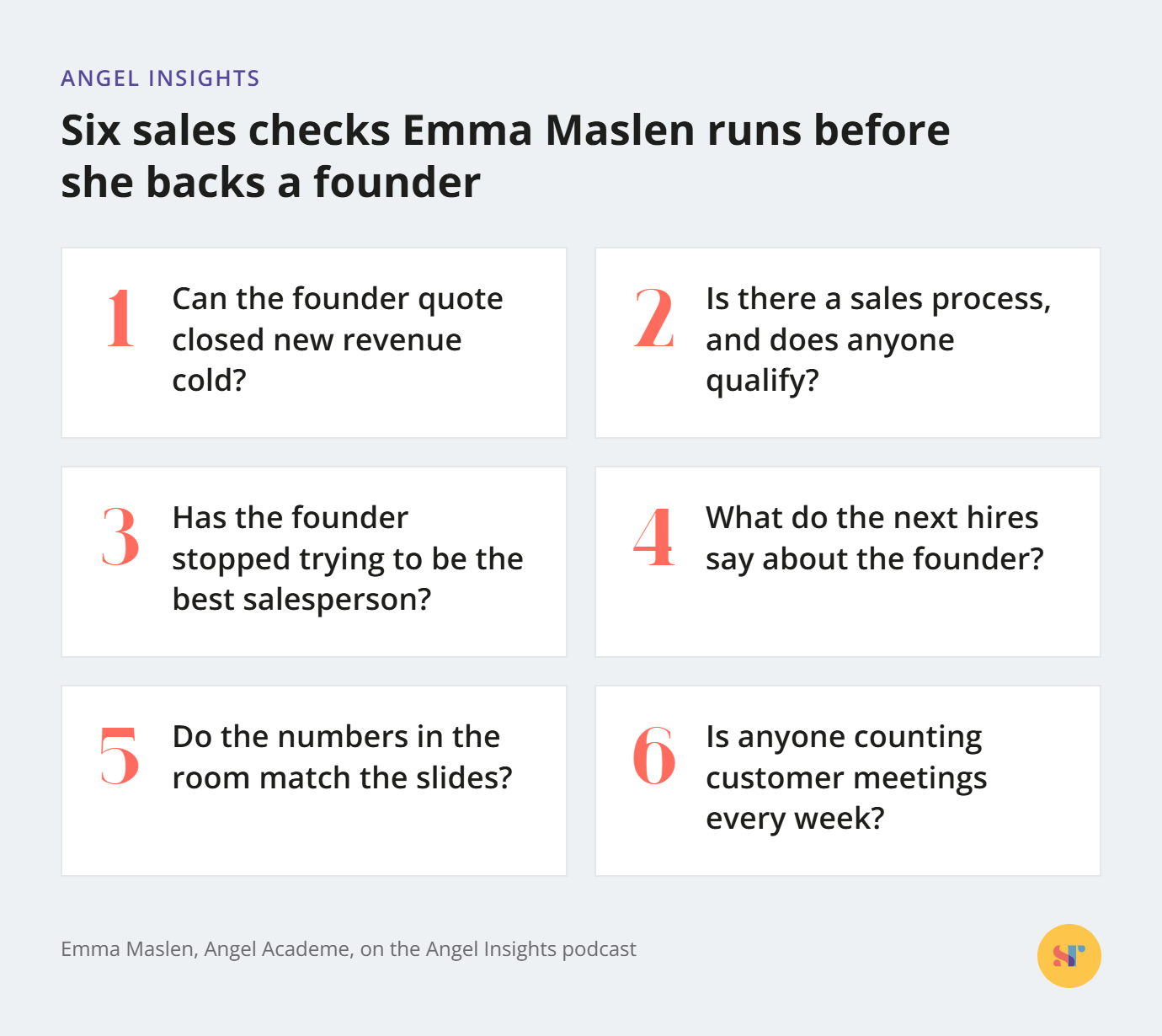
1. What number should every founder be able to quote cold?
Closed new revenue for the period. That's Emma's answer: monthly for most startups, quarterly for enterprise sales.
"Understanding their new revenue acquisition tells me how focused they are on growth."
A founder who knows it cold is watching the front of the business every week. A founder who has to look it up probably isn't. That's the difference between a sales engine that works and one that doesn't exist.
2. Is there a sales process, and does anyone qualify?
At seed stage, the bar is low: having a process at all is a good sign.
"It doesn't have to be right, and it doesn't have to be 100%," Emma said. Several companies she has backed wrote one down, realised their target market was wrong and rewrote it. That's the process doing its job.
A typical process runs discovery, solution, business case, then negotiation and close. The weak point is usually qualification. Emma sees plenty of startups with a "Book a demo" button and a sales team that delivers every demo requested without asking a single further question:
Is this customer in our ideal customer profile?
What do they need to see?
Who makes the decision, and are they in the room?
"Every human wants to be part of the tribe, so we often believe customers rather than actually qualifying."
Buyers are liars. We need to qualify hard.
For an investor, the check is simple. Ask how the team decides a deal is real, and who checks.
3. Is the founder still trying to be the best salesperson?
Founders are always the best salespeople early on. They hold the vision and close the first deals. Emma looks for that, then looks for whether they can hand it over and get back to leading. At some point, she noted:
They still think they're the best salesperson in the company. They're not. They're the best founder in the company.
That does not mean they step out of sales entirely. Founders must focus on where they are needed most. Bill McDermott, who Emma worked for at SAP, and who now runs ServiceNow, still gets involved in the biggest deals, because CEOs want to talk to CEOs. But the founder's job is to show up at key moments, not run every deal. Emma's analogy is football: hold your position and wait for the ball to be passed to you.
When founders don't let go, three things tend to happen:
Deals get dropped because the founder is too busy to follow up.
Positive signals go unqualified. An executive says, "We'll get this done", and nobody maps out what needs to happen next on either side.
The founder loses faith in the sales team, often because they had conversations the team never heard about.
"You can't be in every conversation if you're going to grow a business to 100 million," Emma said. "You are holding yourself back if you can't play in position."
4. What do the founder's next hires say about them?
Emma's biggest turn-off is a founder who thinks they have all the answers. "None of us have." She wants humility and a founder who is "thirsty for new knowledge".
Confidence is part of pitching, so she doesn't test for humility head-on. She asks two questions instead:
What are your next big hires, and why? The answer shows whether the founder sees gaps in their own knowledge, in the commercial model, the financial model or the product, or is simply hiring more of the same.
What have other investors identified as risks? Some founders won't say. The ones who want to work with their early investors usually will.
Both questions are worth stealing. Neither has a rehearsed answer in the deck.
5. Do the numbers on the slides match the numbers in the room?
Back to the Angel Academe pitch. Emma's advice is to know your numbers well enough that the story and the slides agree. Better still, ask investors which numbers they want to see and build the deck from there. Angel Academe's pre-pitch coaching does exactly this: founders are told to have four or five numbers ready behind each claim.
Then there's basic hygiene. "It is amazing how many founders we see that don't have a cash flow," Emma said. Ask for one at a pitch event and the answer is often no.
Nobody expects an early-stage cash flow forecast to be accurate. It shows the founder has done the work. And when a founder doesn't know an answer, the right move is to say so and come back with the number, not to invent one.
6. Is anyone counting customer meetings?
When a business tells inspir'em its growth has stalled, Emma's team first checks how many customer meetings the sales team is having. "You can guarantee that the meetings with customers have fallen off a cliff. Nobody's noticed." It happens in large organisations too.
Her fix for founders is to pick about 10 leading indicators for new customers, retention, and upsell, then measure and review them weekly. Lead generation, deal progression and closing get equal attention. Otherwise, one big opportunity pulls everyone in, the pipeline behind it dries up, and a good quarter is followed by a bad one. Emma calls it "kids around footballs".
Sales is a science. How you deliver it is the art. That's your charisma.
The investor's version of this check: ask what the founder measures weekly, and when they last looked.
What should founders know about their first sales hire?
At seed stage, a startup usually gets one sales hire, so there's no backup if it goes wrong. Emma's advice:
Hire on referral. "I'm sure every recruiter that listens to this is going to have kittens," she said, but it is significantly less risky.
Pay properly. She told two Angel Academe founders not to scrimp. They did anyway, and later told her it was the worst thing they could have done.
Onboard properly. Founders hire an experienced seller and expect them to crack on, then wonder nine months later why it isn't working.
6 months
a realistic onboarding period for a new salesperson. Getting them fully productive for revenue in that time is a good result.
AI makes this harder, not easier. In Emma's experience, the best sellers are the ones using AI well, so B and C players fall further behind. The push to replace SDRs, the junior sales roles that book meetings, with AI agents worries her for a different reason. For 30 or 40 years, SDRs have become account executives, then sales leaders. "Where are our next senior salespeople going to come from?"
Are male and female founders asked the same questions?
No, and it changes how much they raise. Emma says male founders tend to get visionary questions (where is the business going?), while female founders get pinned to specifics: when will investors see a return, and how did you calculate your valuation?
The best-known evidence comes from Dana Kanze and colleagues at Columbia, published in the Academy of Management Journal and Harvard Business Review in 2017. Analysing nearly 2,000 investor questions put to 189 startups at TechCrunch Disrupt, they found investors of both genders asked men more questions about potential gains and women more about potential losses. In a follow-up experiment with 194 angel investors, founders asked the gain-focused questions were allocated twice as much funding.
What do angel investors look for in a startup's sales? Emma Maslen of Angel Academe checks six things: whether the founder knows closed new revenue for the period, whether there is a sales process with real qualification, whether the founder can hand selling to others, what the next hires reveal, whether the numbers match the slides, and whether customer meetings are counted weekly.
What number should every founder be able to quote cold? Closed new revenue for the current period: monthly for most startups, quarterly for enterprise sales. Emma Maslen uses it to test how focused a founder is on growth.
Should founders stop selling as the company grows? Not entirely. Emma Maslen argues that founders should join key deals but stop acting as the main salesperson, because when a founder is in every conversation, it limits how far the business can scale.
How long does it take a new salesperson to become productive? Around six months. Emma Maslen says getting a new salesperson fully productive for revenue within six months is a good result, and founders who skip proper onboarding often see the hire fail around month nine.
Emma is an experienced operator in the Angel Academe network, which has backed 60 female-founded startups across 110 funding rounds since 2014. The Angel Academe EIS Fund 2 invests alongside the network in a portfolio of female-founded startups chosen by its angels.
The fund closes on 30 October 2026, and the minimum investment is £10,000.
Download the Angel Academe EIS Fund brochure
The Angel Academe EIS Fund is the UK's first fund focused on high potential female-founded startups, hand picked by Angel Academe's extensive, female-focused angel network. Register to download the brochure.
Investing in early-stage businesses involves risks, including illiquidity, lack of dividends, loss of investment and dilution, and it should be done only as part of a diversified portfolio. Tax relief depends on an individual’s circumstances and may change in the future. In addition, the availability of tax relief depends on the company invested in maintaining its qualifying status. Past performance is not a reliable indicator of future performance. You should not rely on any past performance as a guarantee of future investment performance.
This page has been approved as a financial promotion by Syndicate Room Ltd, which is authorised and regulated by the Financial Conduct Authority (No. 613021).
We use cookies to improve our service. By continuing to use this site you are agreeing to their use. Find out more. .