Don't invest unless you're prepared to lose all the money you invest. This is a high-risk investment and you are unlikely to be protected if something goes wrong. Take 2 mins to learn more.
Don't invest unless you're prepared to lose all the money you invest. This is a high-risk investment and you are unlikely to be protected if something goes wrong. .
How many companies should an EIS portfolio hold? What our data on 5,393 startups says
Syndicate Room
July 31, 2026
•
6 min read
Tax treatment depends on individual circumstances and may change
Most EIS funds hold 8 to 10 companies — a structure that suits investors who want concentrated exposure to a smaller number of hand-picked opportunities.
But SyndicateRoom's most recent analysis — covering 5,393 UK startups that raised funding between 2012 and 2020, tracked through to 2025 via Companies House filings — found that 38% of individual investments returned less than the capital put in, while only 0.4% reached 100x or more. That's the situation any concentrated portfolio has to navigate: a small number of companies driving the outcome means the specific companies you hold matter enormously, for better or worse.
The maths without EIS relief, and with it
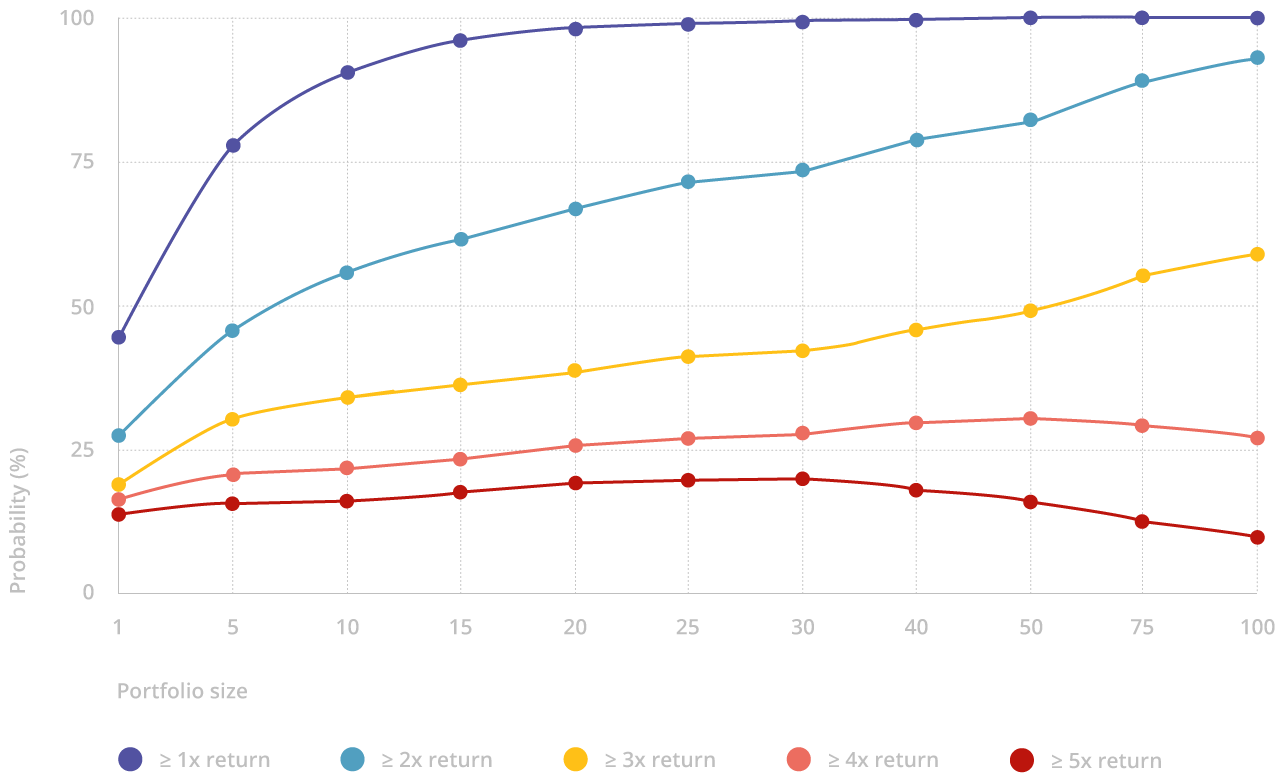
Ask an adviser or a fund manager how many companies is "enough," and the answer is usually a number that feels right rather than one that's been tested. SyndicateRoom modelled it directly: Monte Carlo simulations, run one million times, resampling portfolios of between 1 and 100 companies from that same real return distribution.
Without any tax relief applied, the result is more nuanced than "bigger is always better." The probability of a portfolio returning 3x or more actually peaks around 30–40 companies, then declines beyond 50. That's simply averaging working against you: if roughly half of all investments return less than 1x, each company added past the sweet spot is statistically more likely to dilute the winners than join them, unless it happens to be one of the rare outliers.
Note: this article discusses past performance. Past performance is not a reliable indicator of future results.
EIS relief changes that maths substantially. The scheme's 30% upfront income tax relief and 45% loss relief mean a failed investment costs a higher-rate taxpayer as little as 38.5p for every £1 invested, and a portfolio only needs to reach roughly 2.1x gross to deliver a 3x net return. Modelled with these reliefs included, the probability of a 3x+ return keeps climbing well past 50 companies rather than levelling off — the tax treatment turns diversification from a drag on returns into a genuine advantage. (For the underlying income tax and CGT reliefs referenced here, see HMRC's own guidance.) Tax treatment depends on individual circumstances and may change.
Focus on access to high-quality deal flow is, in our view, even more important than deal selection alone in a power-law market.
Graham Schwikkard|CEO, SyndicateRoom
Why 30, not 50 or 100
If the tax-adjusted maths keeps improving past 50 companies, why does Access EIS target 30 rather than pushing higher? The answer is access, not appetite.
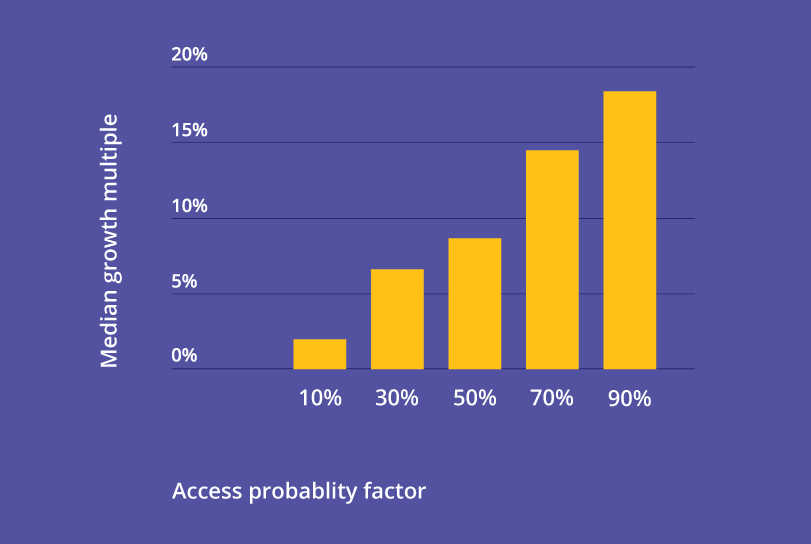
SyndicateRoom's model also runs a quality-correlated "Access Probability" factor, simulating how much of the top-performing end of the market an investor can actually reach — since venture isn't a public market, and most deal flow simply never reaches most investors. At just 10% access to the best deals, a 30-company portfolio's odds of hitting a 3x return are close to zero. At 50% access, they rise to roughly 18%. At 70%, roughly 45%. At 90%, 62%. Access is doing most of the work here, not headcount.
This is also the practical reason the fund doesn't simply extend to 50 or 100+ companies despite the tax-adjusted case for going bigger: expanding a portfolio much beyond 30–40 companies, at realistic levels of access, means diluting the limited number of genuinely strong deals an investor can reach with weaker ones — more of the population, not more of the outliers. Thirty is close to the point where the fund captures the diversification benefit without running out of good deals to fill it with.
Access matters more than picking
SyndicateRoom put a number on this too. Modelled at a fixed 30-company portfolio size, moving from 10% access to 90% access lifts the median portfolio return from 0.45x to 3.59x — an eightfold difference driven entirely by deal-flow quality, with the number of companies held constant. This is the empirical basis for Access EIS's whole structure: rather than trying to out-pick the market, the fund co-invests alongside a small group of angel investors that SyndicateRoom's data identifies as consistent top performers — 183 individuals, or 0.06% of the more than 300,000 UK investors analysed, who have invested in eight or more companies with at least £100,000 deployed and achieved a total return multiple above 5x.
A small number of companies generate the vast majority of the profits — which is exactly why a diversified portfolio matters, to raise the odds of capturing those high-growth outliers.
Graham Schwikkard|CEO, SyndicateRoom
0.06%
of UK angel investors — 183 individuals out of more than 300,000 analysed — have invested in 8+ companies with £100,000+ deployed and achieved a total return multiple above 5x
What this means by ticket size
A £5,000 first allocation and a £50,000+ position face the same underlying maths, just with different practical routes to get there. Building a 30-company portfolio one deal at a time is realistic for a large cheque and a lot of patience; it's not realistic for most individual investors writing smaller cheques into individual deals — and, per the access-probability data above, it's not just about the number of deals but which deals, which is harder still to solve alone.
That's the practical argument for a fund structure over deal-by-deal picking: Access EIS's minimum investment is £5,000, and a single allocation buys into the full 30-company spread in one step, co-invested alongside the angel investors identified above.
The number, and what to do with it
The data doesn't support "as many companies as possible," and it doesn't support a single universal number either. It supports matching portfolio size to two things: the tax treatment available (EIS relief specifically makes larger portfolios mathematically more attractive by cushioning losses) and realistic access to quality deal flow (which caps how much diversification actually helps before it just adds weaker companies to the mix).
For investors building an EIS allocation this tax year, the takeaway is concrete: a fund's headline company count only tells half the story. The other half is whether that fund can genuinely access the top end of the market at that scale — which is a harder thing to verify, but the more important one.
Access EIS is built around both halves of this argument — a 30-company allocation sized to the fund's actual access to quality deal flow, co-invested alongside the angel investors identified in SyndicateRoom's research, rather than assembled deal-by-deal. Minimum investment is £5,000.
The next Access EIS Fund close is 31 July 2026. Is now the time to start building your EIS portfolio? We aim for deployment within a 12 month period (although we can't guarantee this), so investing sooner means your funds have a better chance of deploying this tax year. This will come in handy if you plan to carry back your tax relief to the 25/26 year.
Further reading
The Mathematics of UK Venture Capital (July 2025) — the primary source for this article: Monte Carlo simulations, the Access Probability model, and the EIS-relief-adjusted portfolio construction case
Read our fund brochure for everything you need to know about the Access EIS Fund, which includes a full explanation of our innovative co-investment model to our fees, and instructions on how to invest. Register to download the brochure.
Related Articles
Article
Loading article title placeholder that wraps onto multiple lines
1 Jan 2026 • 10 min
Read article
Article
Loading article title placeholder that wraps onto multiple lines
1 Jan 2026 • 10 min
Read article
Article
Loading article title placeholder that wraps onto multiple lines
1 Jan 2026 • 10 min
Read article
About the author
Syndicate Room|
Syndicate Room is authorised and regulated by the Financial Conduct Authority.
Investing in early-stage businesses involves risks, including illiquidity, lack of dividends, loss of investment and dilution, and it should be done only as part of a diversified portfolio. Tax relief depends on an individual’s circumstances and may change in the future. In addition, the availability of tax relief depends on the company invested in maintaining its qualifying status. Past performance is not a reliable indicator of future performance. You should not rely on any past performance as a guarantee of future investment performance.
This page has been approved as a financial promotion by Syndicate Room Ltd, which is authorised and regulated by the Financial Conduct Authority (No. 613021).
We use cookies to improve our service. By continuing to use this site you are agreeing to their use. Find out more. .