Don't invest unless you're prepared to lose all the money you invest. This is a high-risk investment and you are unlikely to be protected if something goes wrong. Take 2 mins to learn more.
Don't invest unless you're prepared to lose all the money you invest. This is a high-risk investment and you are unlikely to be protected if something goes wrong. .
Materials Nexus: 100 million compositions, three months and a magnet without rare earths
Syndicate Room
November 18, 2026
•
6 min read
Every electric motor has a supply problem built into it
Electric motors and wind turbines run on permanent magnets, and the strongest use rare-earth metals such as neodymium. In 2024 China produced 91% of the world's refined rare earths and 94% of its sintered permanent magnets, according to the International Energy Agency. Most countries are building their energy transition on someone else's supply chain. That supply chain also has an environmental cost: mining and processing rare earths produces acidic and radioactive waste that, badly managed, contaminates water and soil, the IEA says. Under current policies, demand for magnet rare earths is set to grow by a third by 2030.
A magnet without rare earths is the obvious fix. The catch: materials are found by testing one recipe after another, and today's standard magnet took decades to discover, Materials Nexus says.
The limit of what can be built is the materials used to build it.
Dr Jonathan Bean Co-founder and CEO, Materials Nexus
Jonathan Bean and Robert Forrest, materials scientists at Cambridge, turned to machine learning to make their research go faster. Their company, Materials Nexus (now trading as Matnex), built software that predicts how a material will behave, and what it would cost to make, before anyone makes it. It screens millions of candidates and sends only the best few to the furnace. It started with magnets, because that's where the choke point is.
A 17.3x multiple
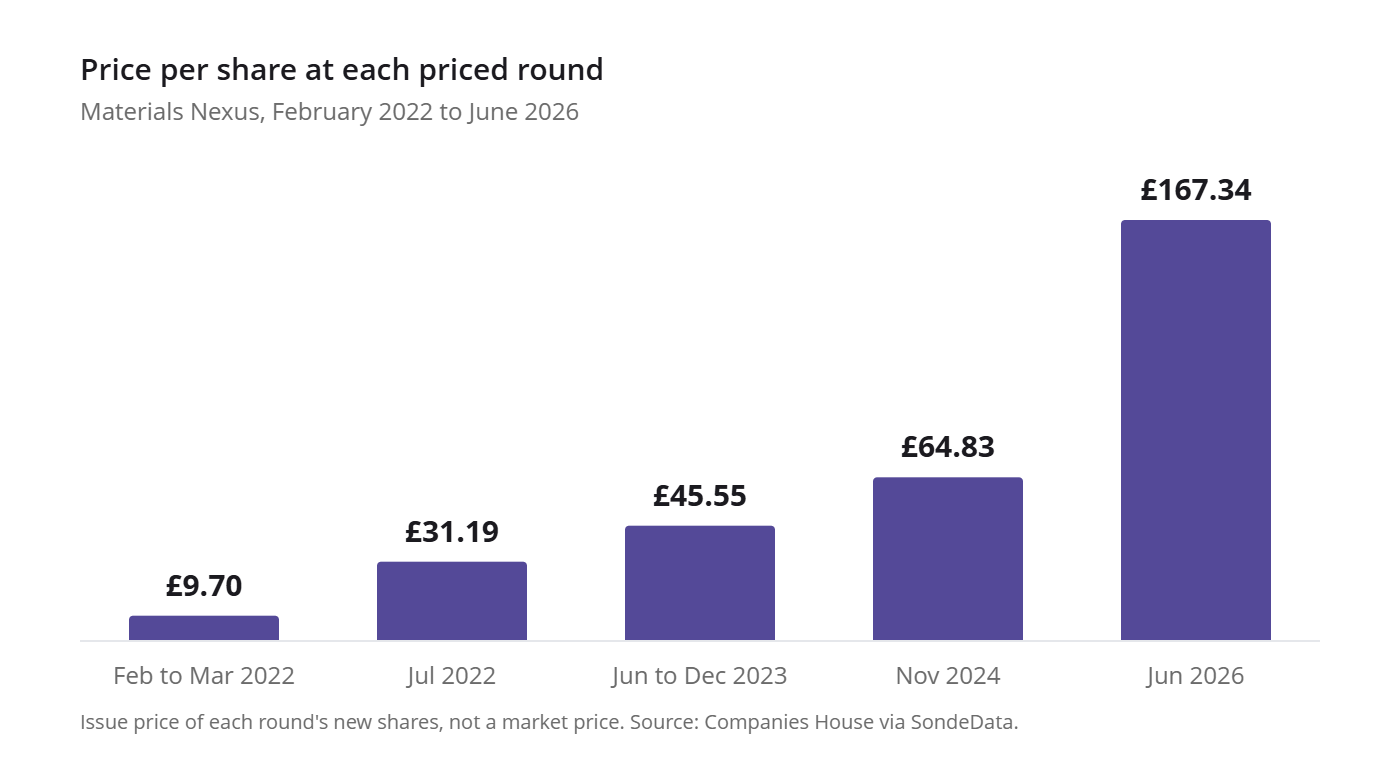
Carbon13's first SEIS fund invested £103,093 in Materials Nexus in February 2022, at £9.70 a share. The company had just come through Carbon13's venture builder. It had no magnet, no seed round and no corporate partner.
The latest round, in June 2026, priced the shares at £167.34. At that price the fund's stake is worth about £1.78m on paper, 17.3 times what it paid per share. That figure is gross of fees and unrealised: no shares have been sold.
Materials Nexus was built through Carbon13
Carbon13 runs a venture builder in Cambridge for people who want to start a climate company. Around 600 apply to each programme and about 80 get a place; roughly one applicant in a hundred ends up in a company Carbon13 invests in. Materials Nexus came out of the second cohort, in 2021.
Nicky Dee, CEO of Carbon13, says the bet was on the people: "They were pitching a faster way to find materials, and I could just tell that they were a brilliant team who'd keep going until it worked. That's what we backed."
That's the model Carbon13 SEIS Fund X is built on: it invests in the companies that come out of the venture builder, at the stage Materials Nexus was at in 2022. Materials Nexus itself was backed by an earlier Carbon13 fund.
100 million+
possible magnet compositions screened by its software
What's happened since February 2022
The first turn was outside money: a £2m seed round in July 2023, led by Ada Ventures with High-Tech Gründerfonds and the University of Cambridge, at £45.55 a share. That's almost five times what Carbon13's fund had paid 16 months earlier.
The second was the magnet. Working with the Henry Royce Institute at the University of Sheffield, the team went from design to a tested rare-earth-free magnet, MagNex, in about three months, and announced it in June 2024. The company estimates the material costs about a fifth as much as rare-earth magnets and carries around 70% less carbon per kilogram of material. Professor Iain Todd, who leads Royce's work at Sheffield, said it was developed "with breathtaking speed".
The third was computing power, which an AI materials company runs on. In February 2025 Materials Nexus announced a partnership with Viridien, the Paris-listed technology group, to scale its computing capacity using Viridien's high-performance computing and AI expertise. A few months earlier, investors had put in £2.7m at £64.83 a share.
Technical results, screening volumes and the cost and carbon estimates in this section are as reported by Materials Nexus.
About 3 months
from design to a tested magnet
What next for Materials Nexus
A magnet designed in three months still has to be made by the tonne, at a price and temperature a motor maker will accept, and qualifying a new magnet material usually takes years.
The company's stated plan has three parts:
Discover. A "universal materials design platform", beyond magnets.
Prove. Tested samples with research partners such as Royce.
Scale. An industrial-scale pipeline, using Viridien's computing.
Where Carbon13's position stands
The fund hasn't added to its 10,628 shares since 2022. It paid the same £9.70 as the angels who came in a month later, so no conversion discount enlarges its multiple. Those shares were 8.75% of the company after the 2022 round and are about 4.2% now.
The share price rose from £9.70 in February 2022 to £167.34 in June 2026 over four priced rounds, set out below. Each of those rounds issued new shares, which is why the fund's percentage stake fell while the price of each share rose.
The funding record
Date
New money
Share price
Who invested
Feb to Mar 2022
£208,000
£9.70
Carbon13's first SEIS fund, angel investors
Jul 2022
£128,000
£31.19
G-Force Fund
Jun to Dec 2023
£2.4m
£45.55
Ada Ventures (lead), High-Tech Gründerfonds, University of Cambridge, Genuine Capital Ventures, angels
Nov 2024
£2.7m
£64.83
Samos Investments, Cartography Capital, Conviction, Ada Ventures, others
Jun 2026
Undisclosed
£167.34
Undisclosed
Source: SondeData using Companies House allotments and confirmation statements. Share price is the price at which each round's shares were issued, not a market price. 2023 new money excludes £360,000 of earlier advance subscriptions that converted at 20% below the round price.
What this means for Carbon13 SEIS Fund X
A subscription to Carbon13 SEIS Fund X goes into the next four to ten companies out of Carbon13's venture builder, at the stage Materials Nexus was at in February 2022, chosen through the same programme. None has been picked yet, and the fund backs companies with the potential to reduce or remove carbon emissions at scale. Materials Nexus is held by Carbon13's first SEIS fund, which SyndicateRoom didn't manage, so Fund X doesn't hold it and the 17.3x above isn't a result Fund X or any SyndicateRoom fund has produced.
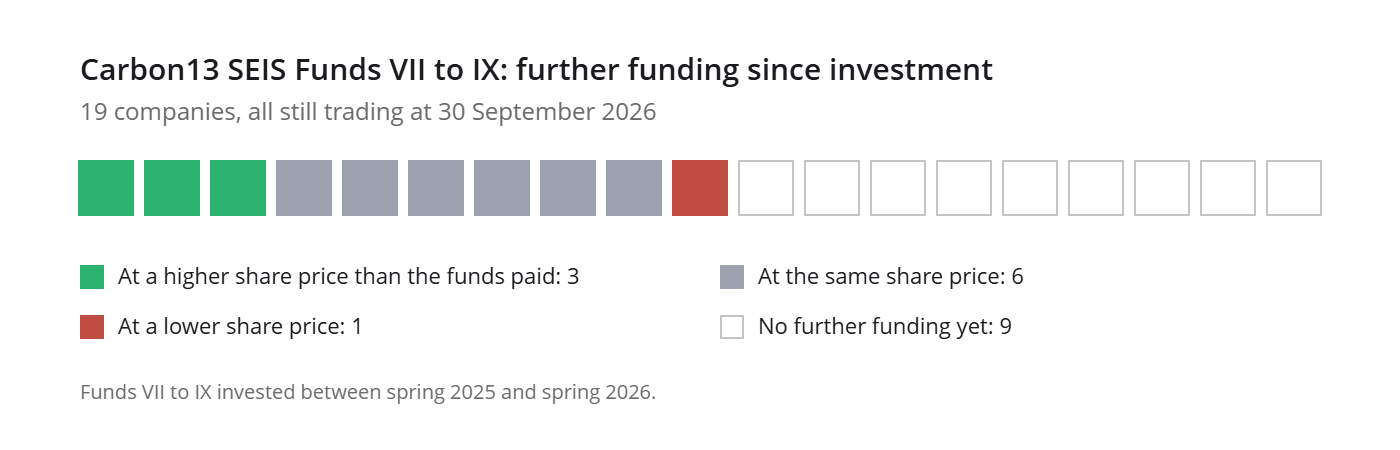
SyndicateRoom has managed Carbon13's SEIS funds since Fund VII. Funds VII to IX invested in 19 companies between spring 2025 and spring 2026, so the oldest are about 18 months in. All 19 were still trading at 30 September 2026. Ten had taken in further funding since: three at a higher share price than the funds paid, one at a lower price and six at the same price.
Carbon13 SEIS Fund X
The minimum subscription is £10,000 and Carbon13 SEIS Fund X closes soon. It is set to invest before the tax year ends on 5 April, so SEIS income tax relief of up to 50%, provided you claim it, would fall in 2026/27, with the option to carry it back to 2025/26. SEIS shares can also qualify for capital gains tax reliefs and loss relief. Tax treatment depends on individual circumstances and may change.
The Carbon13 SEIS Fund brochure
Carbon13's Venture Builder programme forms scientists, engineers and entrepreneurs into founding teams and helps them build companies that aim to cut carbon emissions at scale. Fund X invests in companies from that programme at their earliest stage.
Set to invest in 4 to 10 companies within a single tax year
Up to 50% SEIS income tax relief, depending on your circumstances; tax rules may change
Investing in early-stage businesses involves risks, including illiquidity, lack of dividends, loss of investment and dilution, and it should be done only as part of a diversified portfolio. Tax relief depends on an individual’s circumstances and may change in the future. In addition, the availability of tax relief depends on the company invested in maintaining its qualifying status. Past performance is not a reliable indicator of future performance. You should not rely on any past performance as a guarantee of future investment performance.
This page has been approved as a financial promotion by Syndicate Room Ltd, which is authorised and regulated by the Financial Conduct Authority (No. 613021).
We use cookies to improve our service. By continuing to use this site you are agreeing to their use. Find out more. .